



What Makes Physical AI Safe to Deploy in High-Consequence Environments








Let's start engineering impact together
GlobalLogic provides unique experience and expertise at the intersection of data, design, and engineering.
Get in touch
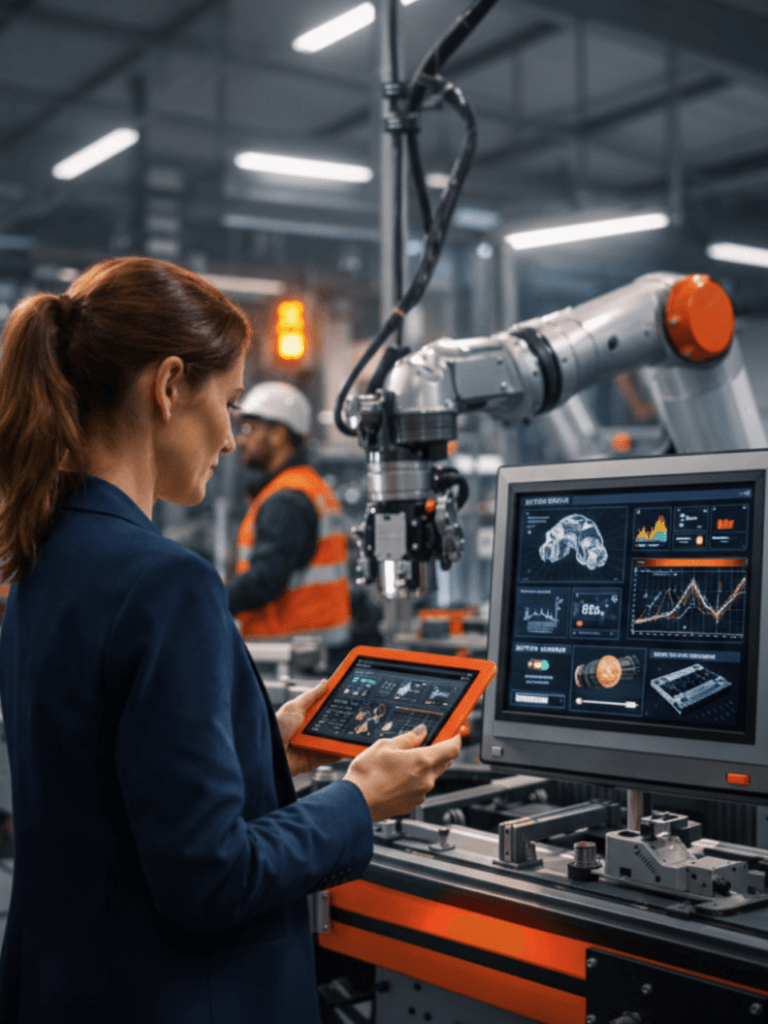
An AI agent that improvises a maintenance step in front of multimillion-dollar semiconductor equipment, or a mobile robot that misreads the space it is moving through, makes a mistake no rollback can undo. It acts on the physical world in real time, with nothing between the decision and its effect. That is the line agentic AI is now crossing: systems that once informed high-stakes decisions now take them.
For the enterprises GlobalLogic builds for, the standard was already high. A misjudged financial transaction or a flawed clinical recommendation carries real consequences, which is why the AI in those systems is held to hard requirements for accuracy, traceability, and governance before it reaches production. What Physical AI changes is the cost of error. The discipline carries over; what changes is that the system acts directly on the world, within the bounds set for it.
For a leader deciding where to deploy, the question is less whether the model is capable than whether the system can be trusted to act under governance that holds when the consequence is immediate and physical. It’s a question CIOs and CTOs are being pushed to answer sooner, as autonomous systems move from controlled demos into live operations.
This is where a capability-first instinct falls short. A model that performs impressively in a controlled demo can still be the one no team will put in front of a technician working alone, or allow into an occupied room, because reliability under real conditions is a different property from raw performance. Deployability is its own engineering problem, and it’s the one that decides whether autonomy ever leaves the pilot.
The Discipline That Makes Autonomy Deployable
Governed autonomy rests on a few engineering commitments that travel across industries.
The first is bounded autonomy. An agent operating near expensive equipment or vulnerable people needs an explicit scope, a defined escalation path, and a clear point at which humans stay on-the-loop. The system is designed to know the envelope it was built for and to stop at its edge, deferring rather than improvising when a situation falls outside what it can answer reliably.
The second is grounded reliability. In a mission-critical environment, an assistant that hallucinates confidently is worse than no assistant at all. Reliable AI pairs the flexibility of large language models with deterministic logic and a curated, versioned knowledge base, so every recommendation traces back to authoritative source material and the path from question to action is auditable.
The third is telemetry, which functions less as monitoring than as the control layer for autonomy. In a physical deployment, telemetry serves two jobs at once: local observability fast enough for safety-critical decisions at the edge, and centralized aggregation that gives the enterprise oversight of how distributed systems are behaving. Escalations, overrides, and human interventions are captured as first-class signals, which is what lets governance be demonstrated rather than asserted.
Together these turn autonomy from a demo into something an operator can stand next to. Two GlobalLogic deployments show the discipline holding in environments with no margin for error.
Bounded Autonomy in a Zero-Error Setting
Semiconductor equipment runs at the edge of what is physically possible. Tools cost millions, fabs run continuously, and a single avoidable hour of downtime cascades through customer schedules. The institutional knowledge that keeps that equipment healthy lives in dense service manuals and in the experience of senior engineers whose numbers are not keeping pace with demand.
GlobalLogic and Hitachi High-Tech are engineering Reliable AI into exactly this setting: guided maintenance for high-precision semiconductor equipment, built to a standard where hallucination is not an acceptable failure mode.
The system is decomposed into scoped agents, each with a bounded role: planning preventive maintenance against equipment health and production targets, allocating technicians by skill and availability, tracking consumables to head off stock-outs, and walking technicians through procedures step by step, grounded in the manual rather than improvised. Each agent has an explicit escalation path and a defined point where a person takes over.
The reasoning foundation is a proof of concept built on a curated subset of the LS9600 maintenance manual: a zero-hallucination engine designed so that when it does not know, it says so, and when it answers, the answer is traceable. That is the principle that makes bounded autonomy real, a system engineered to recognize the limits of what it can answer reliably and to defer at that boundary instead of guessing. Quantified outcomes will follow as the work moves into broader production. The strategic proof is that the discipline holds where tolerance is lowest.
Human-Aware Autonomy Around People
The second deployment moves the same discipline into a space shared with people. Working with Haystack Robotics, GlobalLogic’s Silicon and Embedded division engineered an autonomous mobile robot that turns hospital disinfection into a self-operating process, combining real-time perception, edge-based decisioning, and safe navigation.
The autonomy here is meaningful. The robot interprets its surroundings, adapts to changing layouts, and runs disinfection workflows without manual operation, delivering medical-grade UV-C disinfection at up to 99.99% efficacy in as little as 10 minutes.
What makes it deployable in an occupied environment is human-aware safety designed in from the start. Person detection and tracking, automatic shut-off, and sensor fusion across LiDAR, 3D vision, and cameras let the system operate safely alongside the people around it. The autonomy is real, and it is bounded by an awareness of where people are.
The Same Discipline, Wherever Being Wrong Has a Cost
A semiconductor fab and a hospital corridor look nothing alike, but they share a requirement. Both put an autonomous system into an environment where error has a physical cost, and both become deployable through the same combination of scoped agents, grounded reasoning, observable behavior, and human-aware safety. That pattern travels to any operation built on expensive assets and scarce expertise, energy and mobility among them.
This is the through-line of VelocityAI in the physical world. The business case for Physical AI is measured in outcomes: uptime protected, safety improved, consistency raised, and institutional expertise carried reliably into the moment of decision. Leaders deploy what they can govern, and governed autonomy is what makes those outcomes defensible.
This shift is underway now, and the enterprises that set their bounds early will be the ones that scale autonomy rather than stall in pilots. The useful question is where autonomous systems can act safely in your environment, and under what bounds.
Let’s map where governed autonomy can operate safely in your environment. Get in touch.
 How can I help you?
