- Services
- Industries
Published on December 18, 2025Physical AI: Bringing Intelligence to the Edge of Action
View all articles GlobalLogicShare
Let's start engineering impact together
GlobalLogic provides unique experience and expertise at the intersection of data, design, and engineering.
Get in touchAt GlobalLogic, we’re building systems that don’t just observe the physical world; they interact with it in increasingly intelligent ways. That means combining sensor data with structured knowledge, digital twins, embedded reasoning, and closed-loop feedback.
Physical AI is expanding rapidly in fields like healthcare, where intra-surgical AI can support physicians with real-time image analysis, enabling more confident decisions, faster interventions, and better outcomes. These are high-consequence environments where latency and accuracy matter, and where edge-deployed intelligence is already reshaping what’s possible in real-world environments.
Physical AI in High-Consequence Environments
In one industrial use case, we helped enable real-time decisioning on component health (not in a data center but on the factory floor) using Agentic AI models engineered for low-latency environments and optimized for embedded compute constraints.
In another, we worked with a mobility client to transform telematics into predictive maintenance signals, with agents that adapt routes and schedules autonomously. These autonomous systems are designed to operate safely and efficiently, even in rapidly changing conditions.

Distributed Intelligence Through Multi-Agent Frameworks
Across industries, we see the same evolution: Physical AI empowers systems to reason and respond at the source, transforming raw telemetry into coordinated, contextual action.
This includes support for multi-AI agent frameworks that enable distributed intelligence across digital and physical infrastructure — a pattern we see increasingly supported by AI platforms purpose-built for edge deployment, capable of managing low-latency decisioning, embedded compute constraints, and enterprise-grade governance at scale.
But it’s not just about faster decisions. It’s about better ones, grounded in verifiable facts. As Yuriy Yuzifovich, our CTO, shared in a recent CIO.com article on Industrial AI, even systems without proper knowledge grounding can hallucinate confidently — generating plausible but false answers — in high-stakes environments.
Recommended reading: Industrial AI — Where knowledge (management) is power, at CIO.com
For example, a missing data point in an equipment manual once caused a GenAI assistant to suggest WD-40 instead of the required industrial grease. This is why knowledge-first design isn’t just a feature; it’s a safety requirement.
Building for Trust: The New Standard for Physical AI
For AI to operate safely in physical systems, from surgical suites to rail infrastructure, it must reason reliably, not improvise. That’s why we build Physical AI with structured knowledge, embedded logic, and real-time guardrails. It’s not just about latency. It’s about trust, and the deep engineering disciplines required to ensure it. Our strength in embedded systems, particularly across Europe, uniquely positions us to deliver that trust at scale.
Physical AI isn’t a trend. It’s the new baseline for autonomy in real-world AI deployment, from hospitals and factories to mobility platforms and smart infrastructure. It enables the Agentic Enterprise: a system in which intelligent agents coordinate actions across both digital and physical domains, learning continuously and operating safely at the edge.
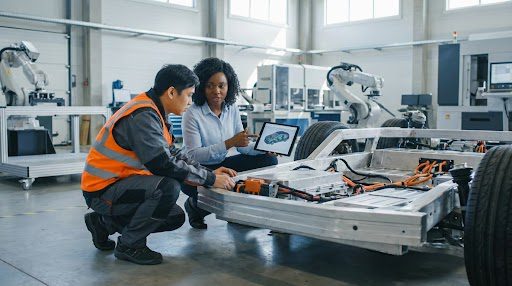
Across sectors, the requirements for Physical AI are converging: systems must operate with low-latency AI, incorporate embedded reasoning, and maintain structured decision guardrails, particularly in environments where decisions carry real-world consequences.
We’re seeing a shift from isolated models to coordinated AI agents that adapt within dynamic systems, guided by frameworks that balance autonomy with oversight. In industries like healthcare, energy, and mobility, digital twins are becoming essential infrastructure—providing a persistent, real-time reference for safe, AI-powered decisioning at the edge.
As organizations move from AI pilots to production, the challenge isn’t just about scaling compute. It’s about scaling trust, which requires ensuring that models perform reliably, that AI hallucinations are mitigated, and that governance mechanisms evolve alongside increasingly autonomous workflows.
Ready to go from dashboards to action? Learn how we design, deploy, and govern intelligent systems that operate at the edge safely, reliably, and at scale.
Download our executive brief on Agentic AI in the enterprise — then get in touch to start the conversation about your AI implementation roadmap.
You might also like:
 How can I help you?
- Industries