

Learning from Co-creation: The Chances of Success in Utilizing Global Resources—Why Transformation was Achieved in Advanced Technology Development (Part 1)


Business model transformation and a shortage of human resources. Hitachi Information & Telecommunication Engineering tackled these difficult challenges through co-creation with GlobalLogic. How did a Japanese company that prioritizes certainty and reliability successfully implement Agile development?
Against the backdrop of rapid business model shifts and a worsening shortage of engineers in Japan, many Japanese companies are being forced to transform. Hitachi Information & Telecommunication Engineering, a company that has supported “Monozukuri” (craftsmanship/manufacturing) within the Hitachi Group for many years, is no exception.
The company chose a path that was not merely offshore development: a co-creation with GlobalLogic, which Hitachi, Ltd. (hereinafter “Hitachi”) welcomed into its group in 2021. While this was an attempt to incorporate “design-led” approaches and “Agile development” into their own operations, the “Japanese style,” which values certainty, and the “global style,” which prioritizes speed, do not easily align.
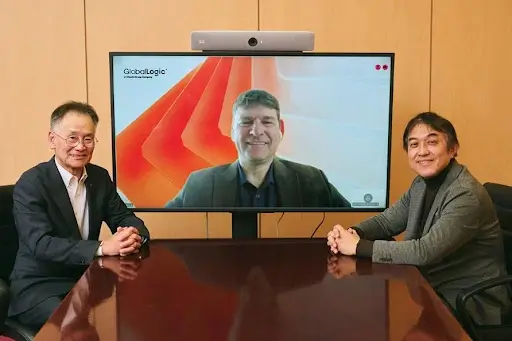
How did the two companies overcome the initial confusion and arrive at a process that leverages the strengths of both? With Shinichiro Fukushima, a leader of the Lumada strategy at Hitachi, acting as moderator, Toshio Nakano, President of Hitachi Information & Telecommunication Engineering, and Marius Vanca, Vice President at GlobalLogic Romania, discussed the reality of a transformation achieved through the strategic use of global resources.
The Dual Pillars of Engineering and Networking
Hitachi Information & Telecommunication Engineering is an engineering firm within the Hitachi Group with approximately 3,000 employees and annual sales of roughly 72.2 billion yen (FY2024). Its business is built on two pillars: “Engineering,” which handles contract development, and “Networking,” which manages network system integration (SI).
“We have a contract development business similar to GlobalLogic’s. Meanwhile, on the networking side, we handle the construction of authentication and security systems for the 230,000 employees of the Hitachi Group,” Nakano explains.
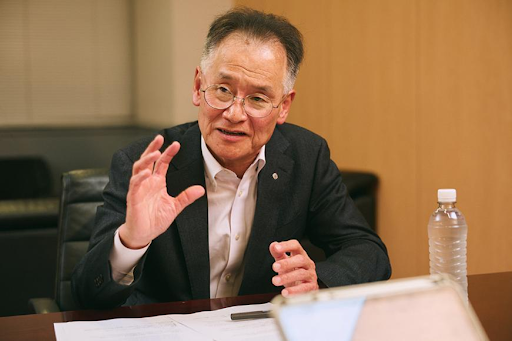
Toshio Nakano (President and Representative Director, Hitachi Information & Telecommunication Engineering, Ltd.)
While their business spans various fields such as automotive and healthcare, the company’s true value lies in the mission-critical domain. “We are responsible for communication systems for police and fire departments. When a call comes in, it must be received; the system must never stop. A connected call must never be dropped. We have supported these highly mission-critical areas.” Nakano’s words reflect the pride of a company that sustains social infrastructure.
The Double Burden: Limits of “Selling Hardware” and Domestic Labor Shortage
The challenges facing Hitachi Information & Telecommunication Engineering are common across the Japanese manufacturing industry. As the communication equipment and services market accelerates its shift from selling devices to providing services, the company was forced to respond. Nakano describes the market shift as follows:
“The model of selling hardware became a thing of the past quite a while ago. Now, the business model itself is shifting toward ‘servitization,’ recurring revenue, or monthly subscriptions like the cloud.”
Another challenge is the shortage of engineers. Although the company continues to hire about 100 people annually, Nakano fears that “in the near future, the shortage of digital talent, in particular, will become severe.”
For a company rooted in hardware, the impact is immense. “That is exactly why we decided that partnering with GlobalLogic, which has deep expertise in hardware as well, was the most logical and efficient choice.”
Fukushima also points out the company’s challenges from a cultural perspective. “While it is a hardware company that values steady manufacturing, in an era of transformation, that culture can sometimes act as a drag.” The limits of selling hardware, the shortage of talent, and the cultural barriers hindering change—co-creation with GlobalLogic was essential as the catalyst to break through all these obstacles at once.
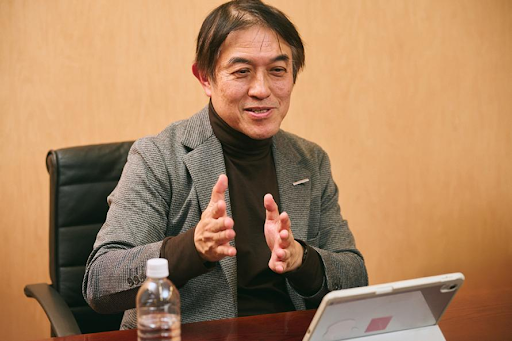
Shinichiro Fukushima (Director, Lumada Collaboration LIHT, Lumada & AI Strategy Headquarters, Digital Systems & Services Strategy Business Unit, Hitachi, Ltd.)
Not Cost Reduction, but a Choice for a Strategic Partner
When hearing the phrase “utilizing global resources,” many executives might immediately think of “cost reduction.” However, what Nakano sought from GlobalLogic was something different.
“There were three main points we emphasized. First is the advanced nature of GlobalLogic—their development speed is extremely fast, and they can build high-quality, high-performance products. Second is their UX design capability. When we do it alone, our UIs tend to prioritize functionality; GlobalLogic can elevate that into a sophisticated design from the user’s perspective. In cloud-based businesses like SaaS, UX is a critical factor that determines competitiveness. Third is trust in them as a partner who can run alongside us for the long term through this transformation.”
Vanca explains the perspective from the GlobalLogic side: “The essence of this partnership is not cost optimization, but mutual complementarity. Hitachi Information & Telecommunication Engineering has domain knowledge and a culture that values quality and reliability. GlobalLogic can provide design-led thinking, cloud-native engineering, and an agile development mindset.”
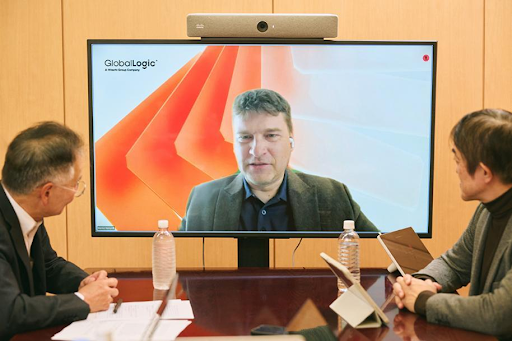
Marius Vanca (Vice President, Engineering, GlobalLogic)
Fukushima admits that he initially viewed GlobalLogic as a company specialized purely in digital and design, and was cautious about their affinity with the on-site culture of hardware development. However, through this case, he gained confidence that GlobalLogic “possesses the foundation to harmonize even with companies close to hardware, like Hitachi Information & Telecommunication Engineering.”
The First Step: Challenging the Cloud-Migration of PBX
The project chosen to embody the co-creation of the two companies was the development of a “SaaS-type Integrated Operations Management Platform” to manage PBX (Private Branch Exchange) systems via the cloud.
A PBX is a device that controls internal telephone systems within companies or facilities, used in hospitals, hotels, schools, and more. The PBX systems handled by Hitachi Information & Telecommunication Engineering utilize technology cultivated in fields like police and fire services and are renowned for their high reliability.
Nakano had a vision to evolve this product into a next-generation telecom server. “Until now, these products were dependent on dedicated hardware with proprietary specifications. I wanted to transform this into a Software-Defined form. By extracting the functions that ran inside the hardware and moving them to the cloud, I wanted to create an environment where services could be accessed remotely from anywhere, free from physical constraints.”
The GlobalLogic Romania team was selected as the development partner. Led by Vanca, this team possesses strengths in cloud-native architecture and full-stack development.
The members of GlobalLogic Japan served as the bridge between Japan and Romania. Language barriers, time zones, and cultural differences—to overcome these, project managers and architects were assigned to both sides, and great effort was put into building a communication foundation, such as establishing regular meetings (details in Part 2).
The Solution: “Hybrid Development”
Once development began, the two companies faced the wall of differing development processes. Hitachi Information & Telecommunication Engineering had long employed the Waterfall method, where requirements are finalized before proceeding step-by-step. In contrast, GlobalLogic excels at the Agile method, which repeats development and feedback in short cycles.
Vanca reflects on the initial situation: “Japanese development culture emphasizes eliminating ambiguity before starting. On the other hand, Agile development accepts a certain amount of uncertainty and evolves solutions through iteration. When we applied the flexibility of Agile without sufficient structural definition, we faced challenges such as scope creep and a lack of visibility toward the final goal.”
Rather than forcing one side to adapt to the other, was there a way to leverage the strengths of both? After much trial and error, they arrived at the solution: “Hybrid Development.”
The development method was selected based on the specific elements of the platform. Parts requiring flexible feedback, such as the GUI operated by the user and the cloud infrastructure, were developed using Agile. GlobalLogic handled this area, developing the UI/UX on Amazon Web Services (AWS).
“Previous PBX systems were command-line based and were by no means easy to use. Our role was to bring in web applications and cloud technology to build a user-friendly interface that could be accessed remotely,” says Vanca.
Meanwhile, parts that required an understanding of the overall picture and absolute certainty—such as the PBX unit itself and the communication control with the PBX—proceeded with Waterfall development. Hitachi Information & Telecommunication Engineering was responsible for this area.
The API design connecting the two was also carefully crafted. “We tried not to touch the existing PBX logic as much as possible, making it possible to add features as add-ons. We had countless discussions on how to optimize the APIs and translate GlobalLogic’s vision into a technically implementable form,” says Nakano.
The development workflow adopted the GlobalLogic style. Nakano notes that they adopted the methods and tools used by GlobalLogic for man-hour estimation and issue management, with the “Hitachi Information & Telecommunication Engineering side learning as we went.”
“The Power of People” Beyond the System
The hybrid framework adopted by the two companies is logical, but that alone does not guarantee success. How did teams from different cultures build trust? It involved a mutual respect that cannot be captured in a blueprint.
Nakano calls this co-creation “Harmony” (Yuwa) rather than just “Integration” (Yugo). What is the true meaning behind this? In Part 2, we will look at the reality of this harmony, the specific results achieved, and the keys to successful global resource utilization.
Click here https://www.globallogic.com/insights/case-studies/japanese-quality-and-global-speed-can-coexist-the-reality-of-transformation-captured-by-hitachi-information-telecommunication-engineering-part-2/ to read Part 2.
Related Content

Let’s start engineering impact together.
GlobalLogic provides unique experience and expertise at the intersection of data, design, and engineering.
 How can I help you?
