



Telemetry Data and the Architecture of Reliable AI









Let's start engineering impact together
GlobalLogic provides unique experience and expertise at the intersection of data, design, and engineering.
Get in touch
Artificial intelligence does not operate in isolation. In enterprise environments, it exists within systems — software systems, operational systems, regulatory systems, and physical systems. The performance of an AI model is only one variable in a much larger equation.
What determines whether AI delivers sustained value in production is not only its reasoning capability, but the quality of the signals that surround it; the data that informs it, constrains it, monitors it, and governs it in real time.
That signal layer is telemetry data.
Telemetry as Governance Infrastructure
In traditional software environments, telemetry has been considered an afterthought; a byproduct of system activity. Logs are captured, metrics are streamed, traces are stored. The primary question is performance: latency, uptime, throughput.
Agentic AI systems shift that equation.
When AI systems are embedded into workflows — approving transactions, routing cases, generating documentation, adjusting production parameters, recommending financial actions — telemetry becomes more than performance monitoring. It becomes behavioral monitoring.
Enterprises no longer need to observe only whether a system is running. They need to observe how it is deciding:
- Which knowledge sources informed the response?
- Which policies were triggered?
- Which constraints were enforced?
- What confidence thresholds were applied?
- When did the agent escalate to a human?
These are not debugging questions. They are AI governance questions. Telemetry, properly architected, becomes the mechanism that transforms AI from a black box into an auditable system of record.
The Three Pillars of AI Oversight
In most organizations, telemetry is treated as an operational concern. It is captured for observability dashboards, post-incident reviews, or system performance tuning. Rarely is it elevated to its proper architectural role.
Yet in production-grade AI systems, telemetry is not peripheral. It is a foundational capability. It provides the empirical evidence required to demonstrate that a system is safe, unbiased, and compliant. A disciplined telemetry architecture underpins:
- Agent Supervision: providing the real-time signals required to monitor autonomous behavior and multi-agent coordination.
- Policy Enforcement: enabling runtime auditing of guardrails to ensure business rules are followed at every step of the reasoning chain.
- Regulatory Traceability: Generating the immutable audit trails required for compliance, especially in regulated sectors.
Without a disciplined telemetry architecture, AI becomes opaque. Without visibility, it becomes ungovernable. And without governance, enterprise-scale deployment becomes untenable.
The Production Gap Is a Governance Gap
The enterprise AI conversation frequently centers on model quality. But production failures and legal liabilities rarely stem from model performance alone.
According to recent HFS research surveying 100 industrial enterprises, 51% of organizations cite skills gaps as the primary reason their AI and advanced technology initiatives fail or underperform. Beneath that statistic lies a structural issue: organizations lack the operating frameworks required to deploy AI responsibly.
Telemetry architecture is one of those missing frameworks. Without defined telemetry standards:
- There is no shared language for measuring AI behavior.
- There is no consistent mechanism for tracking Decision Lineage.
- There is no runtime visibility into policy enforcement.
- There is no systematic feedback loop to improve agents safely.
In many enterprises, AI pilots succeed in controlled environments but stall during integration. Another HFS finding underscores this challenge: 49% of organizations identify integrating new technologies with legacy systems as their greatest barrier to advanced digital deployment.
Telemetry is the connective tissue that makes integration tractable.
“The transition from ‘AI Experiment’ to ‘AI Enterprise’ happens the moment governance shifts from static, ‘paper-based’ governance to active, operationalized oversight. In an agentic world, transparency isn’t just a compliance requirement—it’s an operational necessity. If you can’t trace the reasoning, you can’t manage the risk.”
– ShanShan Pa, Global Head of AI & Data Governance
Recommended reading – Powering Up with Purpose: Responsible AI in Grid Modernization
Telemetry as the Control Layer for Agentic AI
Agentic AI introduces a new complexity profile. Unlike isolated AI models responding to discrete prompts, agentic systems coordinate across workflows. They retrieve data from enterprise systems, apply reasoning patterns, trigger downstream actions, and collaborate with other agents.
This orchestration layer demands structured visibility. Each agent requires:
- Input telemetry: context signals, system state, data freshness indicators
- Decision telemetry: reasoning traces, policy checks, confidence scores
- Action telemetry: system updates, API calls, escalations, and most importantly — Human Overrides
- Outcome telemetry: results, performance indicators, exception events
Without this layered telemetry model, orchestration becomes brittle. Agents may function individually but fail collectively.
Reliable AI depends on enforceable guardrails. Guardrails, in turn, depend on observable behavior. If runtime policies cannot be measured, they cannot be enforced. This is where telemetry evolves from a monitoring tool to an architectural control system.
Telemetry as Strategic Alignment
Enterprise AI does not exist in isolation from broader strategic transitions. Sustainability initiatives, workforce transformation, and modernization efforts intersect with AI deployment.
Telemetry supports these transitions by making performance measurable:
- Predictive maintenance that reduces downtime.
- Energy optimization that lowers consumption.
- Workflow orchestration that increases throughput.
These outcomes are validated through telemetry. When telemetry is structured, organizations can connect AI initiatives to executive metrics — cost reduction, uptime, efficiency, and sustainability impact.
Without telemetry, AI remains a technical experiment. With telemetry, it becomes an operational lever.
Telemetry in Distributed and Edge Environments
As AI expands beyond centralized applications into distributed and edge environments, telemetry complexity increases.
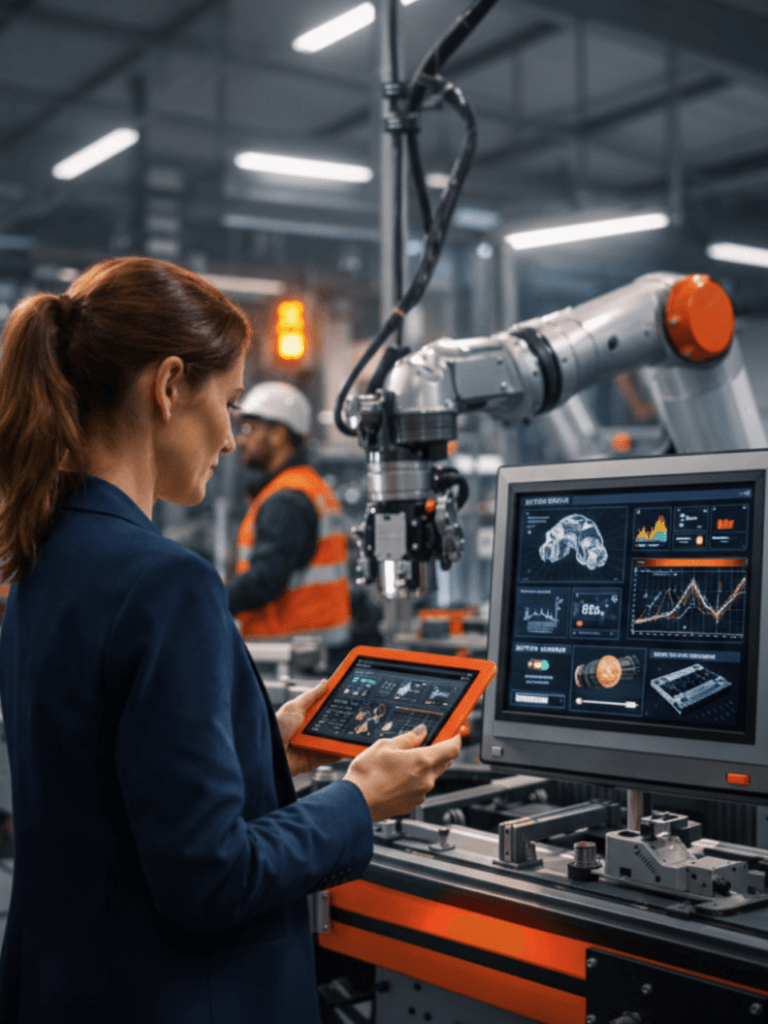
Physical systems, IoT devices, and embedded controllers operate under latency constraints. Decisions may occur in milliseconds. Connectivity may be intermittent. In these contexts, telemetry serves dual purposes:
- Local observability for safety-critical decisions.
- Centralized aggregation for enterprise oversight.
A digital twin validating edge behavior, for example, relies on synchronized telemetry streams from both physical assets and simulated environments. The integrity of the twin is only as strong as the fidelity of the telemetry it receives.
This is particularly relevant in industrial sectors where AI optimizes energy consumption, predicts equipment failure, or manages distributed assets. HFS research indicates that 47% of executives flag cybersecurity, privacy, and regulatory concerns as major barriers to AI deployment. These concerns intensify where telemetry becomes the mechanism that provides assurance that edge intelligence adheres to enterprise governance, even when decisions occur far from centralized control.
Governance Only Works If It Is Observable
In regulated industries, governance cannot be aspirational; it must be demonstrable. Compliance teams require audit trails. Security teams require traceability. Executives require assurance that AI systems align with business policy.
Telemetry enables that assurance. Consider three governance layers common in enterprise AI deployments:
- Policy Enforcement: Agents must operate within predefined business rules. Telemetry must capture when policies are invoked, when constraints are triggered, and when exceptions occur.
- Explainability: For high-stakes decisions, organizations require visibility into reasoning pathways. Telemetry should capture structured reasoning traces, not only final outputs
- Human Oversight: Agentic systems must escalate appropriately. Telemetry must record when escalation thresholds are met and how human interventions alter outcomes.
Without telemetry, governance exists only in design documentation. With telemetry, governance becomes operational. Reliable AI is not achieved by limiting capability. It is achieved by embedding transparency into execution.
Recommended reading – Realizing the value of enterprise-grade AI: From proof-of-concept to real-world problem-solving
From Signal to Feedback Loop
Telemetry is often misunderstood as passive recording. In production AI systems, it is an active feedback mechanism. A mature telemetry architecture enables:
- Continuous model evaluation against real-world outcomes.
- Drift detection based on behavioral signals.
- Policy adjustment based on exception frequency.
- Orchestration tuning based on workflow bottlenecks.
Telemetry closes the loop between design intent and operational reality. This feedback loop is particularly critical as enterprises move from AI experimentation to AI orchestration. Isolated bots may tolerate limited feedback. Agentic ecosystems cannot.
When agents coordinate across systems, small errors compound. Without telemetry-informed refinement, those errors remain invisible until they surface as operational failures.
Why Telemetry Is Underprioritized
If telemetry is so central, why is it frequently underdeveloped? Three structural reasons emerge across enterprise environments:
- Separation of Concerns: AI development teams focus on model quality. Platform teams focus on infrastructure. Governance teams focus on compliance. Telemetry spans all three domains, yet often belongs to none.
- Legacy System Constraints: Many organizations operate on fragmented architectures. Instrumentation standards vary. Data pipelines lack consistency. Telemetry normalization becomes complex.
- Skills and Operating Model Gaps: As HFS research indicates, skills shortages remain a primary barrier to AI scale. Designing telemetry for AI governance requires cross-disciplinary expertise — engineering, security, data architecture, and business policy alignment.
These are architectural and organizational limitations, not technological ones. Enterprises that treat telemetry as a strategic capability (not a logging exercise) are better positioned to operationalize AI responsibly.
Designing Telemetry for Reliable AI
Production-grade AI systems do not become reliable by accident. They are engineered that way. Telemetry, when treated as infrastructure rather than instrumentation, should follow several core architectural principles:
Telemetry by Design: Instrumentation is embedded during system development, not layered on after deployment.
Standardized Signal Models: Consistent, formatted schema across agents and workflows, enabling aggregation and cross-system analysis.
Policy-Linked Telemetry: Runtime policy enforcement is explicitly logged, making governance measurable.
Human-Interaction Capture: Escalations, overrides, and manual adjustments are captured as first-class signals, not secondary artifacts.
Distributed Compatibility: Pipelines are designed to function across cloud, hybrid, and edge environments.
These principles are not about selecting a specific observability toolset or technology stack. They define an architectural posture.
Reliable AI is rarely constrained by model sophistication. It is constrained by the environment in which that model operates. Telemetry defines that environment. And in agentic systems — where multiple agents reason, collaborate, and act across enterprise workflows — telemetry becomes the connective tissue that keeps orchestration governed, measurable, and aligned.
From Experimentation to Engineered Intelligence
The move from AI experimentation to enterprise deployment is not marked by larger models or faster GPUs but by architectural discipline. And telemetry is central to that discipline.
It ensures that:
- Agents operate within defined boundaries.
- Decisions remain traceable and auditable.
- Distributed systems stay aligned across business domains.
- Feedback loops continuously refine behavior.
- Human oversight becomes measurable — not anecdotal.
In enterprise environments, trust is not granted based on potential. It is earned through observable behavior.
Telemetry makes that behavior visible.
This is particularly critical in industrial, regulated, and mission-critical sectors. According to HFS Research, 47% of industrial executives cite cybersecurity, privacy, and regulatory concerns as primary barriers to deploying AI at scale. Governance anxiety is not a theoretical concern, it is a structural inhibitor to AI adoption.
When systems lack transparency and measurable guardrails, enterprises hesitate. They cannot operationalize what they cannot observe.
Telemetry does not eliminate complexity, but it is what makes complexity governable.
Similarly, reliable AI is not about dampening ambition. It is about constructing the systems that make ambition sustainable — systems that can withstand audit, scale across geographies, and adapt without destabilizing operations.
For organizations seeking to move beyond pilots and into production-grade agentic ecosystems, the strategic question shifts. It is no longer: “How intelligent is the model?”
It becomes: “How visible, governable, and measurable is the architecture in which that model operates?”
Telemetry data — deliberately architected, policy-linked, and human-aware — answers that question.
And in doing so, it forms a core control layer of what we call the Agentic AI Fabric: an enterprise architecture where governed agents collaborate across workflows, systems, and decision domains engineered for scale, not experimentation.
That’s why, within VelocityAI, telemetry is embedded into our Agentic Runtime, ensuring governed orchestration across distributed systems, not added after deployment.
If you are rethinking how to move from isolated AI pilots to orchestrated, production-grade intelligence, we explore this architecture in depth in our executive brief:
Engineering the Agentic AI Fabric: A New Architecture for Enterprise Scale

Download the full POV to understand how telemetry, orchestration, governance, and human-in-the-loop design converge into a scalable foundation for Reliable AI.
 How can I help you?
