- Services
- Industries
 All News
Japanese “Quality” and Global “Speed” Can Coexist: The Reality of Transformation Captured by Hitachi Information & Telecommunication Engineering (Part 2)
ShareTransformation cannot be achieved simply by setting up systems. How did Hitachi Information & Telecommunication Engineering and GlobalLogic overcome language and cultural barriers to build trust? We take a closer look at the reality of the “harmony” that produced results and the mindset shift spreading across both companies.
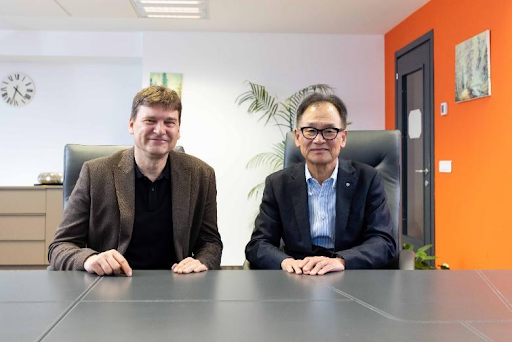
Japanese “quality control,” characterized by the proverb “knocking on a stone bridge before crossing it” (extreme caution), versus global “speed,” where one “crosses the bridge first” to see what happens. To solve the challenges of labor shortages and the shift away from purely hardware-based sales, Hitachi Information & Telecommunication Engineering ventured into utilizing global resources. How did they bridge this decisive cultural gap?
In Part 1, we introduced the background of why Hitachi Information & Telecommunication Engineering embarked on this co-creation with GlobalLogic, as well as the “hybrid development” framework that combines Waterfall and Agile methodologies. However, a project does not succeed simply by putting a system in place. This article explores the outcomes of this co-creation and the changes that occurred within both companies.
Visible Results Driven by Early Feedback
The results of hybrid development were clearly reflected in the numbers. In September 2025, Hitachi Information & Telecommunication Engineering launched its “SaaS-type Integrated Operations Management Platform” (see Part 1 for details). The development period was just over one year—a speed unimaginable under conventional development methods.
In the Proof of Concept (PoC), approximately 87% of users gave high ratings. Features that improve the efficiency of routine operations, such as monitoring, log collection, and reporting, were highly praised, and expectations were also voiced for AI utilization and UI improvements. “By showing working software to customers at an early stage, we were able to obtain meaningful feedback,” recalls Marius Vanca, who leads the GlobalLogic Romania team involved in this collaboration.
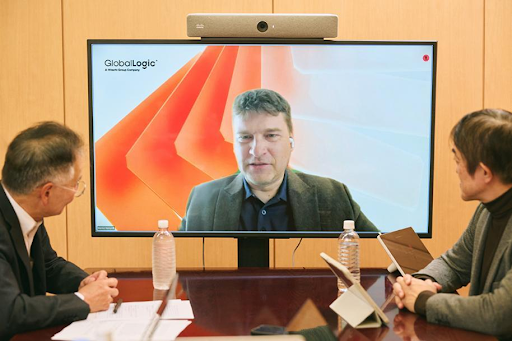
Marius Vanca (Vice President, Engineering, GlobalLogic)However, the road was not always smooth. In the first half of development, the number of defects was 1.6, exceeding GlobalLogic’s standard value of 0.37. These numbers are generated from our internal testing environment, due to the fact that we decided together to skip the standard testing time and offer Hitachi Information & Telecommunication Engineering the possibility to test directly on the code. The “Horizontal Approach”—or “Yokotenkai”—is what bridged this gap between Agile speed and Japan’s unique quality control.
“We don’t just stop at fixing one defect; we use horizontal thinking to verify others. By learning this ‘Yokotenkai’ from Hitachi Information & Telecommunication Engineering, our quality improved significantly,” says Vanca.
Through the thorough implementation of horizontal expansion combined with customer feedback, the number of defects in the latter half of development reportedly improved to 0.3.
GlobalLogic was not the only one to change. Toshio Nakano, President of Hitachi Information & Telecommunication Engineering, says, “We had the motivation that we ourselves had to transform. We chose the path of thoroughly learning GlobalLogic’s methods and standing on the same playing field.”
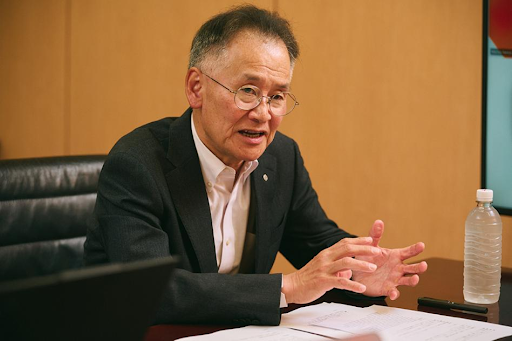
Toshio Nakano (President and Representative Director, Hitachi Information & Telecommunication Engineering, Ltd.)The Keyword is “Harmony,” Not Just “Integration”
Shinichiro Fukushima, who promotes the Lumada strategy at Hitachi, Ltd. (hereinafter “Hitachi”), praised GlobalLogic’s “patience” after hearing about the process the two companies followed.
“Hitachi has its own strict quality control processes. For a company that excels at Agile development, it is not easy to adapt to such meticulous protocols. It wouldn’t have been surprising if they thought, ‘We want to prioritize efficiency and focus solely on software development.’ I have always wondered where that ‘patience’ came from.”
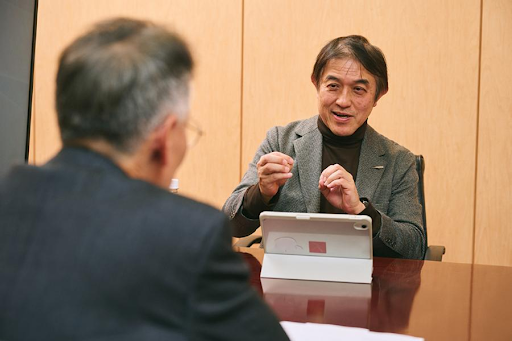
Shinichiro Fukushima (Director, Lumada Collaboration LIHT, Lumada & AI Strategy Headquarters, Digital Systems & Services Strategy Business Unit, Hitachi, Ltd.)In response to Fukushima’s question, Vanca cited the keyword “Harmony.”
“It wasn’t so much patience as it was a harmony that naturally emerged between the teams. Meeting in person and working through problems face-to-face—by sharing those ‘unpolished’ moments of hard work, a relationship of trust was fostered that transcended methods and processes.”
Nakano defines this co-creation not as “fusion” (integration), but as “Harmony” (Yuwa). “It is about leveraging and respecting each other’s strengths. It is not a vertical relationship of ‘client and contractor,’ but the form of partners sharing a common goal.”
Both parties agree on the critical importance of face-to-face communication. Workshops, joint design sessions, and regular in-person meetings played a decisive role in building trust. Supporting this close collaboration were the members of GlobalLogic Japan. Nakano remarked, “Their contribution was immense, as they were able to understand the cultures and values of both sides.”
Their role went far beyond simple translation; they played a vital part in deepening mutual understanding by sharing the “why”—the underlying background—of the requirements being exchanged between Hitachi Information & Telecommunication Engineering and GlobalLogic. By having GlobalLogic Japan act as a “bridge” with a deep understanding of both cultures and contexts, gaps in perception were kept to an absolute minimum.
As a result, Vanca notes with a smile, “As time passed, the teams began to appreciate not only each other’s technical strengths but also their underlying values.”
This trust was supported by a “foundation” common to both companies. Nakano states, “Both companies had a foundation of earnestness toward quality and craftsmanship (Monozukuri). Even when people with completely different ways of thinking and cultures spoke, there was never a sense of being ‘out of sync.’”
Fukushima refers to the essence of this relationship as “Co-creation.”
“Rather than the vertical relationship common in outsourced development, they respect and complement each other as professionals. Even if this is discussed as an ideal, not many companies can actually practice it. What matters is not the method, but whether there is a base that allows for harmony. GlobalLogic has that. That is why Hitachi Information & Telecommunication Engineering’s challenge was able to become a true co-creation.”
Mindset Reform Spreading Beyond Development
The change brought about by this co-creation did not stop at the development site. It spread to the “front end”—including Quality Assurance (QA), product managers, and sales—helping to dissolve departmental silos.
The nature of Agile development, where one can interact with “working software” at an early stage, lowered the walls between departments. In traditional Waterfall development, the sales department has limited opportunities to get involved until the product is finished, but this time was different. Sales members also participated in workshops, engaging in repeated discussions about product value directly with the Romania team.
This mutual approach also triggered a shift in mindset. While GlobalLogic deepened its understanding of mission-critical quality and long-term responsibility, Hitachi Information & Telecommunication Engineering absorbed iterative development and design-led thinking.
The impact on young engineers has also been significant. Through discussions with GlobalLogic, they were exposed to a flat overseas corporate culture. “It seems a sense of ‘thinking and creating for oneself’ has sprouted,” Nakano says.
“Employees feel the significance of being able to work borderlessly with an overseas company. Above all, they have gained the confidence that ‘we can change the legacy world ourselves.’ That is a great joy for me.”
The Horizon of Co-creation Beyond the PBX Project
The success of the PBX project has generated a significant response both internally and externally. Nakano says, “When I introduce this success model, the reaction is very strong. I want to apply it to our contract development business as well.”
The scope of collaboration is also expanding. “Collaboration with Mobiveil, which recently joined GlobalLogic, has also begun. They are a group of professionals based in India, specializing in semiconductors and embedded hardware technology.” Nakano notes that they have started initiatives combining Mobiveil’s technology with Hitachi Information & Telecommunication Engineering’s expertise in areas such as healthcare, automotive, and IoT Edge.
Vanca echoes this: “Several PoCs, such as AI-enabled platforms, are already underway. We will formulate a common strategy for market launch and take our ‘harmony’ to the next level.”
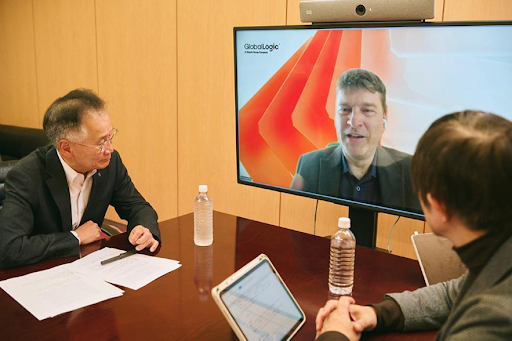
Nakano’s vision includes contributing to the digital transformation of the entire Hitachi Group. Hitachi is promoting Social Innovation Business by combining IT, OT, and products, centered around “Lumada.”
Note: Lumada is Hitachi’s advanced digital solutions, services, and technologies platform.
“The method we demonstrated with the PBX—turning a standalone system into software-defined and connecting it via the cloud—can be applied to other areas, such as medical devices. I believe Hitachi Information & Telecommunication Engineering can contribute to Lumada through these modernization practices,” says Nakano.
Looking even further ahead is the world of Edge AI. Nakano concludes, “In the future, AI will be embedded on the edge side, and systems will make autonomous decisions and act. I am confident that together with the GlobalLogic team, we can realize such a new world.”
Vanca nods at these words and speaks about the ultimate form of partnership GlobalLogic aims for.
“Our ultimate goal is not just to act as a development proxy. It is to support ‘insourcing,’ where our partners acquire the ability to develop on their own. By absorbing advanced engineering knowledge and culture, our partners can strengthen their own ‘engineering DNA’ while connecting to the global ecosystem. That is the value we want to provide.”
To All Executives Aspiring for Transformation
At the end of the interview, Fukushima brought up a “common struggle” shared by many Japanese companies.
“Even if the top management shows a vision with strong will, the front lines don’t move—I hear this constantly from executives challenging DX. Mr. Nakano, as a leader, how did you engage with the front lines to overcome this wall?”
Nakano’s answer was “Patience” (Nintai) as a leader. “What we learned in co-creation is the ‘patience’ to not seek immediate results, and the importance of upfront investment. It takes courage to stay quiet and wait until results appear. But if you invest first, it creates the resources, changes the people, and changes the products. DX is something that only bears fruit beyond that point.”
Beyond investment, “attitude” is required. Vanca explains that “transformation is not a matter of company size, but a matter of will and leadership,” offering a perspective that transcends simple dichotomies.
“It is important to design a model where quality and speed reinforce each other, rather than choosing one over the other. With a strong will, an open attitude, and the right partners, any company can achieve transformation.”
On the other hand, Fukushima is well aware of the steepness of that path. As if to warn against easy optimism, he says, “DX through co-creation is not easy. The most difficult part is the mindset change, and doing it ‘your own way’ is often a recipe for failure.” He emphasizes the importance of utilizing the knowledge of those who have gone before.
“The Hitachi Group has a wealth of knowledge, including this success story. I want people to consult us before taking a long detour. By utilizing our experience, Japanese companies should be able to become even stronger.”
The process of “Harmony” practiced by Hitachi Information & Telecommunication Engineering likely holds the hints for the transformation that Japanese companies should strive for.
Click here https://www.globallogic.com/about/press-room/media-coverage/learning-from-co-creation-the-chances-of-success-in-utilizing-global-resources-why-transformation-was-achieved-in-advanced-technology-development-part-1/ to read Part 1.
 How can I help you?
- Industries