- Services
- Industries
Published on March 24, 2026How Agentic AI Is Powering the Programmable Media Ecosystem
View all articles GlobalLogicShareRelated Content
 GlobalLogic19 March 2026
 GlobalLogic10 March 2026View All Insights
 Serhiy SemenovAdam RadlinskiMichal CelejewskiMykhailo Morhal1 March 2026
Let's start engineering impact together
GlobalLogic provides unique experience and expertise at the intersection of data, design, and engineering.
Get in touchAgentic AI is reshaping the media landscape, powering a new kind of programmable, orchestrated intelligence across content operations. In this post, we unpack what that means and how leading media orgs are putting it into action.
Prefer to share or save a copy? You can download the full POV here.
Modern media operations are highly automated, impressively global — and deeply fragmented. Over the past decade, the Media industry has digitized nearly every part of the content lifecycle. From cloud-based production to GenAI-assisted editing, automation has accelerated speed and scale across the board. Yet complexity has grown just as fast.
As AI-powered channels multiply, brands must diversify just to stay visible. It’s stretching operations, splintering budgets, and increasing risk across delivery, compliance, and monetization.
Most media organizations are now investing in AI, yet few are orchestrated by it.
Workflows remain reactive. Tools don’t talk to each other. Editorial, playout, and monetization systems each optimize in isolation, missing the bigger picture. AI copilots may generate outputs, but rarely know what to do next — or whether they even should.
The projected global AI in media and entertainment market by 2030 is expected to reach $100 billion by 2030, a 20+ percent CAGR from 2024 onward.
That’s a massive bet on AI.
But inside most broadcasters and streamers, that spend still shows up as disconnected tools and point solutions — copilots in edit bays, isolated tagging services, ad‑hoc automations — rather than orchestrated, agentic workflows that run against explicit goals for playout, yield, and compliance.
Agentic AI rebuilds that model as a governed execution fabric: agents consume goals, environment state, and guardrails, then plan, call tools, and adjust behavior based on feedback loops.
Instead of static workflows, you get adaptive, policy-bound processes that are instrumented end to end for monitoring, rollback, and human intervention.
This is how leading media companies are shifting from fragmented pipelines to intelligent, adaptive ecosystems.
In this POV, we’ll unpack what Agentic AI really means for media, including how it works, where it’s already delivering results, and how you can take the first step without overhauling everything.
What Agentic AI Means for Media
For more than a decade, media companies have implemented automation. Workflows are faster, smarter, and more scalable than before, but they are still fundamentally reactive, simply responding to triggers, following static rules, and escalating to humans whenever real judgment is required. The industry is in the middle of an evolution, and agentic AI is what finally shifts that equation.
Generative AI produces candidate outputs; agentic AI operationalizes them, orchestrating where they are delivered, how they are parameterized and personalized, and when they are modified in a closed-loop based on live telemetry and policy constraints.
Agentic AI is the shift from “asking models for answers” to “running the business against explicit goals.” It is the layer that doesn’t just generate copy or clips, but continuously senses operational state, audience behavior, rights and yield constraints, then decides and executes the next best action across scheduling, playout, QC, personalization, and ad decisioning.
“AI isn’t something you bolt on. It’s the connective tissue of the media ecosystem — it learns, calls things, builds things.”
Scott Davis, CTO, Media & Entertainment
GenAI gives you content on demand; agentic systems give you accountable, policy-governed outcomes at scale. This is not another workflow tool; it is the connective tissue of a new operating model for content, distribution, and monetization.
In media, this means systems that don’t just assist, they orchestrate:
- Promo agents that build, schedule, and localize creative automatically based on rights windows, audience sentiment, and market context.
- Yield agents that monitor live ad performance, adjusting load and sequence in real time to balance revenue with viewer experience.
- Compliance agents that prevent rights or brand violations before distribution, not after.
- Metadata agents that curate, tag, and enrich assets at the moment of creation, ensuring discoverability from day one.
All agentic systems share three defining capabilities
Autonomy: They act without step-by-step instruction, operating as trusted collaborators. Intent Awareness: They understand not just what to do, but why — aligning actions with creative, commercial, and operational goals. Governed Adaptability: They learn safely over time, always within traceable policy and human oversight. This is already in production
Early deployments are wiring creative, operations, and monetization into a single adaptive system that cuts latency, improves uptime, and lets people shift from manual triage to higher-value work in creativity, strategy, and storytelling.
For media executives, the architectural distinction is significant. Traditional automation executes predefined tasks against static rules and workflows. Agentic AI encodes intent and policy as first-class objects, orchestrating services, data, and tools across the stack.
It turns fragmented pipelines into an intelligent, interoperable execution fabric that can evaluate context, select and parameterize actions, adapt to changing conditions, and escalate to humans with traceable reasoning when thresholds or guardrails are hit.
That connective layer is what moves a modern media organization from reactive incident handling to orchestrated intelligence: systems that are not just faster but policy-driven, intent-aware, instrumented for audit, and designed to scale under load.
From Creative Silos to Adaptive Ecosystems

Operationally, media companies run on one of the most fragmented ecosystems in any industry.
Creative, ops, ad sales, rights management, and playout systems each have their own workflows and data, but very little shared data or control between them. As assets move across these silos and tools, the system accumulates risk, increases time to air, and burns cycles on avoidable fixes.
Agentic AI rewrites how these systems behave in practice.
It introduces a new connective layer across all facets of production, not replacing systems but coordinating them. Intelligent agents operate across creative pipelines, ad platforms, compliance systems, and distribution infrastructure to form orchestrated media workflows that adapt in real time.
At the heart of this transformation is a new paradigm: media as a programmable object. Media assets are no longer static files or streams passed between silos.
They become self-describing, logic-enabled entities — carrying their own metadata, rights, intent, and behavioral rules.
“We moved from discrete systems to a programmable architecture where media and data come together — and AI is the engine that makes it go.”
Scott Davis, CTO, Media & Entertainment
In a programmable environment:
- A publication system knows when and where it can air a trailer, and in what versions.
- A live feed can be automatically segmented, tagged, and re-monetized with minimal human touch.
- A compliance agent can validate every frame against policy before it hits playout.
- Metadata agents that curate, tag, and enrich assets at the moment of creation, ensuring discoverability from day one.
This vision is anchored in open, interoperable standards that matter specifically to the Media & Entertainment industry.
Agentic systems in this industry require more than generic frameworks; they need to operate using the same semantic signals and policy constructs that govern professional media workflows.
SMPTE ST 2110 enables true IP-native routing for video, audio, and ancillary data. ST 2067 (IMF) provides the componentized, version-aware packaging essential for localized and multi-market distribution.
SCTE-224 becomes the semantic layer that allows agentic systems to reason about rights, windows, blackouts, and policy conditions in the language the industry already uses.
When SCTE-224 signals are combined with GlobalLogic’s approach to transform rules, policies, and knowledge to knowledge-as-code, agents no longer treat rights and policies as static metadata. They can interpret constraints, correlate them with assets and schedules, and adjust decisions in real time based on codified business rules. This is the difference between “metadata-aware” and “policy-aware” AI.
To support multi-agent collaboration, we also integrate emerging A2A (Agent-to-Agent) protocols. These open standards allow agents responsible for scheduling, compliance, rights, and monetization to coordinate directly, resolve conflicts, and adapt workflows without human bottlenecks.
Together, ST 2110, IMF, SCTE‑224, TAMS APIs, and A2A standards provide the interoperability fabric for media-specific agentic ecosystems — where creative, operational, and commercial decisions can be executed reliably, with shared semantics, across the entire organization.
The result is a media ecosystem built not just for scale, but intelligence, speed, and real-time orchestration.
Where It’s Working Today: Media Use Cases
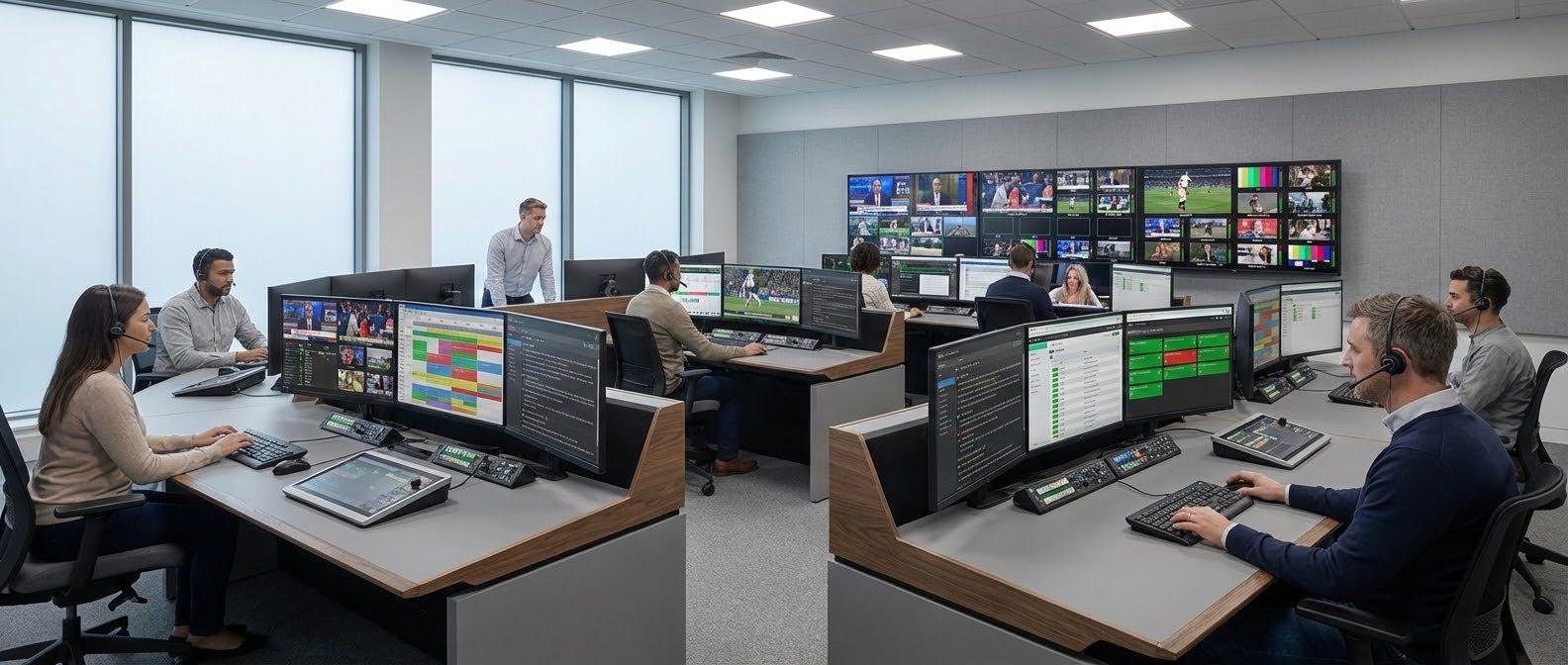
The value of Agentic AI in Media is no longer hypothetical.
Across the content supply chain, media teams are already deploying intelligent agents that move beyond assistance toward autonomy with oversight, adaptation with accountability.
That shift — from afterthought to in-process — exemplifies how Agentic AI redefines media workflows end-to-end. Here are a few examples of what it can look like in action.
Broadcast CoPilot
In live operations, Agentic AI supports real-time observability. Agents monitor runtime system health, preemptively detect anomalies, and either resolve issues autonomously or escalate them to human operators with context-rich diagnostics.
They don’t just spot faults — they build institutional memory to reduce downtime and speed resolution.
Some agents even simulate full live workflows, acting as digital twins to stress-test systems, predict failures, enabling content owners to preemptively solve issues before the customers are ever affected.
“Metadata has always been the weak horse in media — built too late, too inconsistently. Agents embedded at the edge of the network or in the editorial suite can fix that, tagging and curating as part of the process, not after.”
Scott Davis, CTO, Media & Entertainment
Dynamic Promo Generation
Promotion timelines are shrinking, and manual A/B testing is no longer scalable. Agentic systems ingest audience behavior, asset metadata, rights windows, and performance trends to generate and localize promos without human prompting. They continuously test, learn, and optimize based on engagement metrics — across platforms and markets.
Automated Compliance & Rights Enforcement
Instead of post-distribution takedowns, agents proactively enforce content rights and regulatory standards at the point of delivery. They scan for profanity, logos, and time- or geography-sensitive content, all in real time, reducing compliance risk and reputational damage.
Ad Yield Optimization Agents
These reinforcement learning agents dynamically balance ad load, sequencing, and campaign pacing in real time. They adjust strategy based on user fatigue, regional thresholds, and inventory availability, protecting brand experience while maximizing revenue.
Metadata Curation & Enrichment
Agents now live inside ingest systems, editorial UIs, and playout tools — auto-tagging, clustering, and curating metadata as content flows through the pipeline. They enable personalized recommendations, smarter search, and version-aware content reuse at scale.
Each one is a foundational capability, not a standalone tool. Together, they form a responsive media ecosystem — one that sees, learns, and acts with purpose across creative, operational, and commercial domains.
Governance Isn’t a Limiter — It’s the Enabler

In Media, where content moves fast and consequences move faster, governance is not a constraint but a requirement for trust. GlobalLogic embeds governance into the core of every agentic system.
We call this the Trust Stack — a layered architecture that ensures every action is explainable, escalatable, and accountable by design.
- Policy defines what agents can do, and what they must not.
- Provenance tracks data lineage and decision history, ensuring traceability.
- Oversight gives humans ultimate authority to approve, override, or intervene.
This structure supports a human-as-overseer model, which is more scalable and secure than traditional “human-in-the-loop” methods. It ensures that agents align with business intent, escalate exceptions appropriately, and adapt only within defined parameters.
In high-integrity environments — from global playout to regional compliance — this model is critical. Agents must perform with permission, proof, and under pressure.
With GlobalLogic’s approach, autonomy and accountability aren’t competing goals. They’re engineered to work together, enabling speed, adaptability, and control within a single system. In the programmable media ecosystem, governance isn’t a constraint — it’s the architecture of trust.
Building the Programmable Media Ecosystem
The media industry has embraced digital tools, but orchestration remains elusive. Disconnected systems — from creative to playout to monetization — lead to friction, lag, and lost opportunity.
Agentic AI changes the model.
With governed agents that understand intent, act autonomously, and adapt over time, media workflows become intelligent ecosystems — responsive, reliable, and revenue-ready.
This is the future of media: programmable assets, intelligent orchestration, and always-on optimization.
At GlobalLogic, this isn’t theory. It’s production reality, and it’s backed by VelocityAI, a proven governance foundation, and 20+ live agents in enterprise use today.
Let’s evolve beyond automation. Let’s build the programmable media ecosystem — designed to think, adapt, and scale — and let’s do it together.
GlobalLogic: A Proven Partner in Modern Media

Building agentic AI in media requires more than models. It demands deep domain knowledge, secure execution frameworks, and architectures that embed governance from day one.
Grounded in Media Engineering
GlobalLogic brings more than a decade of experience building high-performance video, audio, and metadata systems. We have delivered production platforms across broadcast, streaming, and publishing, spanning ingest, QC, playout, and monetization.
This hands-on experience gives us a practical understanding of the real constraints media systems operate under: uptime, latency, signal integrity, cost control, and managed risk.
We apply state-of-the-art multimodal AI that works natively with video frames, audio waveforms, and time-based metadata.
These frontier models are combined with traditional machine learning and proven agentic design patterns to create AI-enabled systems that operate at the speed and fidelity required for live and on-demand media.
Designed for Real-World Execution
At GlobalLogic, AI is designed into customer platforms from the start, not added later as a bolt-on feature. Agents operate inside execution frameworks, not above them. They are components of a system, not independent actors.
Access is explicit, scoped, and intentional.
Agents run with defined permissions, approved actions, and enforceable policies. They do not have blanket visibility or unrestricted control. What an agent can see, decide, and execute is determined by the framework it runs within, not by the model itself.
This approach ensures predictable behavior, operational safety, and full accountability. It is essential in production environments where compliance, auditability, and trust are non-negotiable.
We have delivered this model in high-integrity industries such as manufacturing and financial services, and are now applying it to media, where rights management, provenance, and traceability are equally critical.
Our development framework, VelocityAI, is built to deploy agentic systems reliably at scale and includes:
- Proven blueprints for building sophisticated, production-grade AI systems
- Modular components that can be composed into end-to-end solutions
- Trusted AI capabilities across language, vision, and domain-specific reasoning
A Clear Maturity Model for Agentic AI
Agentic transformation is progressive, not immediate. We guide clients through a staged path:
Level 1: Assisted Workflows (Human-in-the-Loop)
AI POCs assist with high-friction tasks, but humans remain the primary drivers of execution. Systems generate insights, summaries, or recommendations — such as summarizing dailies, generating metadata, or retrieving archive content — but every action requires manual review and initiation.
Outcome: Productivity gains, but humans are still the bottleneck.
Level 2: Semi-Autonomous Workflows (Human-in-the-Loop)
Agents begin taking goal-based actions with explicit human oversight. AI can execute defined steps — for example, generating and scheduling a localized promo package — but humans approve decisions, resolve conflicts, and manage handoffs between systems.
Outcome: Faster execution, but scalability is limited by review cycles.
Level 3: Autonomous Workflows (Human-on-the-Loop)
End-to-end workflows operate autonomously within defined goals, policies, and constraints. Multiple agents coordinate dynamically — for example, rights and scheduling agents resolving conflicts in real time — while humans oversee performance, handle escalations, and refine policies rather than managing day-to-day execution.
Outcome: Continuous adaptation at scale, with humans focused on governance and strategy instead of operations.
“Agentic AI is different: it’s a once-in-a-generation chance to reinvent technology, operating models, and the human fabric of the enterprise — how people, teams, and partners collaborate and create value.”
Yuriy Yuzifovich, Chief Technology Officer, AI
How to Get Started: Your Safe, Testable Path to Production
Agentic transformation doesn’t require a rip-and-replace overhaul. At GlobalLogic, we follow a proven, incremental path that turns high-friction media workflows into intelligent, orchestrated systems with trust and control built in from day one.
1. Capture & Digitize Your Core Knowledge
We begin by capturing your most valuable operational assets: rights and compliance policies, playout rules, metadata standards, and the tacit expertise of your most experienced teams. This forms a reusable, auditable knowledge base — the operational brain of your agentic system — powering consistent, intelligent decision-making across content and monetization workflows.
2. Create Real-Time Operational Visibility
We integrate with your existing systems to capture live signals across your media operations — including asset metadata, distribution schedules, platform performance, audience behavior, and compliance flags. This gives AI agents a continuous, end-to-end view of the content lifecycle, enabling intelligent orchestration, rapid escalation, and proactive response.
3. Orchestrate Across Systems
Our agentic loops are built on open standards, enabling them to safely coordinate across your creative, playout, ad tech, rights, and data infrastructure without locking you into proprietary workflows. Agents can plan, call tools, and adapt across platforms.
4. Drive Continuous Improvement
This creates a powerful feedback loop: agents continuously learn from real-time signals, human oversight, and operational outcomes to improve over time. Media teams gain deeper visibility into evolving behaviors — enabling smarter planning, faster delivery, and reduced risk.
5. Scale Value & Create New Opportunities
This approach can scale across promo creation, compliance enforcement, metadata curation, and ad yield optimization — compounding efficiency and resilience. In some cases, it even unlocks new services, such as dynamic content personalization or predictive ops, transforming operational excellence into a competitive advantage.
Ready to move from exploration to execution with GlobalLogic?
Let’s identify the media workflows that are ready for orchestration—and map your path to intelligent, adaptive operations. No hype. No pitch. Just a clear, actionable plan for where Agentic AI can deliver value next.
Let’s see if it’s a fit:
 How can I help you?
- Industries