
- Services
- Industries
Published on January 13, 2026AI-Native Networks: Engineering the Future of Intelligent Telecom
View all articlesGlobalLogicShareRelated Content GlobalLogic10 March 2026
 Serhiy SemenovAdam RadlinskiMichal CelejewskiMykhailo Morhal1 March 2026View All Insights
 GlobalLogic23 February 2026
Let's start engineering impact together
GlobalLogic provides unique experience and expertise at the intersection of data, design, and engineering.
Get in touch
AI-Native Networks: Engineering the Future of Intelligent TelecomAs the telecom industry redefines its role, two prominent industry leaders recently sat down to examine what comes next. Krishna Iyer, Vice President & Group CTO (Communications, T&H, and Cybersecurity) at GlobalLogic, was joined by Montgomery Hong, Worldwide Communications Industry Business Strategy Lead at Microsoft, to discuss the critical evolution of networks from bandwidth-driven infrastructure to intelligence-first platforms.
Recent McKinsey research shows that 88% of companies already use AI in at least one business function, signaling a fundamental shift in how organizations operate. For telecom, this shift aligns with the approach of the 6G era, where networks will be judged less by speed and more by how intelligently they respond to human and business intent.
The session explored how operators can adopt AI-native design, address foundational challenges, and prepare for autonomous, adaptive networks—where intelligence, not bandwidth, defines progress.
Why AI, Not Bandwidth, Defines the Future of Telecom
In his keynote, Krishna Iyer traced telecom’s evolution from 2G through 5G, noting that each generation focused on the same metric: bandwidth. Faster speeds, lower latency, and greater capacity defined innovation—until now. “Bandwidth alone is no longer the benchmark,” Iyer said. The next phase will be led by intelligence: networks that are aware, predictive, and autonomous.
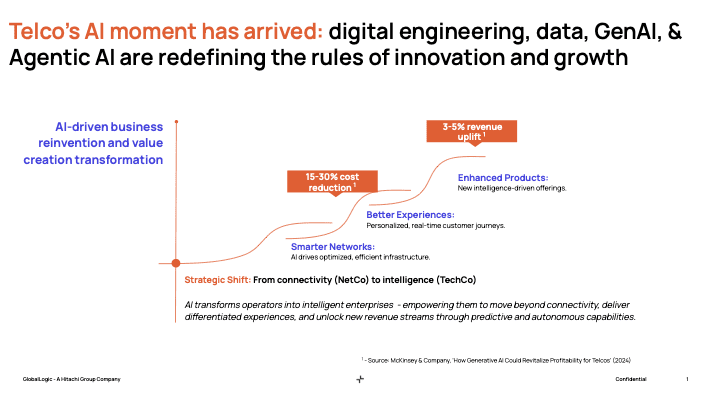
This shift signals a move from a network-centric to an AI-centric industry. While AI already plays a role in customer experience, network optimization, and OSS/BSS modernization, Iyer emphasized that scaling remains difficult. Fragmented data, regulatory complexity, and legacy systems slow progress. Real impact requires trusted integration, strong governance, and cloud-native foundations.
Partnerships are critical to making this transition real. By combining the engineering expertise of GlobalLogic with the hyperscale and edge-to-cloud capabilities of Microsoft Azure, operators can modernize infrastructure, deploy secure AI, and deliver intelligent experiences at scale. Frameworks like VelocityAI from GlobalLogic help accelerate adoption by building confidence in model deployment and operations.
Looking ahead, Iyer described 6G networks as self-learning and self-healing, where intelligence becomes the “control plane,” unifying “connectivity, compute, and cognition.” Operators that adopt AI-native architectures today, he predicted, will shape the next era of telecom innovation.
Moving from AI pilots to AI-native networks
The panel discussion shifted focus from vision to execution, how operators can move beyond isolated AI pilots to production-grade, AI-native networks. Together, Iyer and Montgomery Hong explored what it takes to modernize legacy systems, operationalize intelligence, and close the “AI execution gap.”
Iyer emphasized, “The first thing that I would focus on is building a unified cloud-native layer that abstracts intelligence from complex RAN, core, and edge capabilities into standardized, developer-friendly APIs.” He noted that operators handle vast assets—edge computation, location services, real-time analytics—but much of this intelligence remains trapped behind proprietary systems. “To monetize the network, telcos must make it more standardized, leveraging APIs in a consistent, standardized approach.”
Iyer highlighted the transformative potential: “With exposure layers in place, the network stops being a rigid hardware asset and becomes very programmable…Telcos can move from selling connectivity to selling capabilities.” Hong reinforced this, calling for a shift “from the vertically integrated hardware model to a much more layered approach—the decoupling—enabling developers to interact with a composable, programmable software layer.”
The Three Pillars of Scaling AI: To break out of the “Proof of Concept” (POC) cycle, Iyer outlined a three-pillar strategy:
- Governance: An integrated council to manage ethics and risk.
- Methodology: A unified lifecycle for model development.
- Operations: Scalable AI operations (AIOps) through automated monitoring.
The Rise of Agentic AI and Hyper-Personalization
Agentic AI emerged as a game-changer for complex networks. Iyer explained that it allows networks to “sense, reason, and act autonomously.” Hundreds of operational decisions can be completed in months or hours, improving reliability, latency, and enterprise success. Hong added, “Agents never sleep. They process large amounts of data, freeing up human actors.”
Customer experience is the ultimate payoff. Iyer noted, “If we can identify and fix issues before the customer realizes them…it reduces churn, increases NPS scores, and drives higher ARPU.” Hong concluded, “The ability to deliver hyper-personalization allows you to create loyalty, stickiness, and monetization opportunities” across the entire value chain.
The discussion underscored that building an AI-native network requires harmonized engineering, robust governance, scalable AI operations, and a relentless focus on transforming intelligence into personalized customer experiences.
Conclusion: The Era Starts Now
As the session concluded, Iyer reiterated that the industry is at an inflection point. The transition to the 6G era requires operators to adapt faster, realize ROI sooner, and unify fragmented data.
Ready to bridge the AI execution gap? The transition to an AI-native network requires more than just new software—it requires a fundamental shift in engineering and strategy. Whether you are modernizing legacy systems or looking to deploy Agentic AI, GlobalLogic is here to help you navigate the 6G era.
Contact our experts today to start your journey toward an intelligent, autonomous network.
 How can I help you?
- Industries