




Enterprise Knowledge as Infrastructure: Five Takeaways for Data and AI Leaders









Let's start engineering impact together
GlobalLogic provides unique experience and expertise at the intersection of data, design, and engineering.
Get in touch
A healthcare board recently expressed concerns with an AI transformation program that seemingly had nothing wrong with it. The economics worked. The efficiency gains were credible and the automation opportunities were well documented. The board said no anyway, and its objection had nothing to do with cost. It asked what strategic advantage the program created, given that competitors had access to the same classes of model, the same tools, and the same capabilities.
What can an organization learn that others cannot easily replicate, and can scale turn that learning into an advantage that compounds?
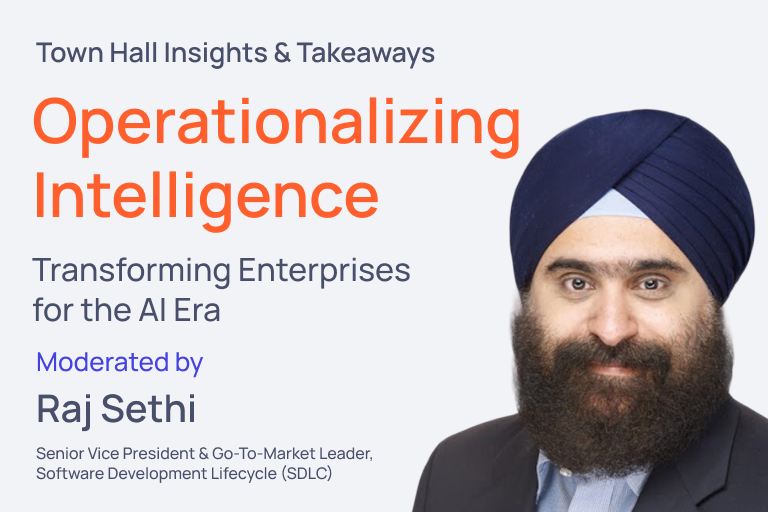
Raj Sethi, Senior Vice President and Go-to-Market Leader for Software Development Life Cycle at GlobalLogic, opened with that question at a Gartner C-Level Community Town Hall sponsored by GlobalLogic. It reframed the session around a harder question than automation scope.
The panel brought together data and AI leaders from asset management, insurance, and direct-to-consumer business. They arrived at the same conclusion from three different starting points, and five takeaways stood out for data and analytics leaders working on the same problem.
1. Data Is Inventory; Knowledge Is the Asset
One panelist noted that in their organization, there is no meaningful separation between AI and enterprise knowledge, because the work of AI is transferring institutional intelligence into systems that can act on it. Models, retrieval architectures, and tooling are the means of that transfer.
Data alone does not qualify. Two panelists described their data as an enabler rather than the advantage itself — decades of it, much of it unstructured, waiting to be unlocked. The asset is the tacit knowledge accumulated across decades of professional judgment, much of it sitting in systems and in people’s heads. In investment management, that includes years of conversations with company leadership that were never structured for retrieval. In a consumer business with continuous customer contact, the structural advantage is the interaction volume, but only if there is a mechanism that converts interaction into learning.
One described an unlock he had not anticipated. The same conversational agent let him observe what questions employees were actually asking, rather than relying on the stated requirements that arrived as dashboard requests, and that became a feedback loop into what to build next.
2. What a Data and AI Leader Can Own
Sethi put a question to the panel: should the CDAO own enterprise knowledge, or own the mechanisms through which enterprise knowledge is governed?
One panelist answered without hesitation. No individual can own enterprise knowledge, almost by definition. What a data and AI leader can own is the enablement system that captures it, curates it, and makes it available at the moment of decision.
Another named two roles that follow from that. The first is semantic and metadata management, which he argued can be machine-drafted but requires thorough human review and has to be kept current. In his organization, the analytics engineers hold it.
The second is a function rather than a named role. It is the work of tracing insights through to business outcomes – maintaining a record of what was learned, what action followed, and whether it moved anything. One expert put that with his analysts, and noted the job has arguably never existed, which is why most organizations are not doing it today.
Another agreed and gave the point some history: consultants had been pushing his company toward “decision management” for years, and the company resisted, because the core problem was getting the right information out rather than managing the decisions themselves. What has changed is that the record now has to cover not just which decisions were made, but what information was available when they were made, and what was not.
Where stewardship sits, centrally or in the business, is a function of organizational size and maturity, not principle. One leader in finance described his organization as reasonably mature at the data layer and considerably less so at the interpretation layer, where insight is generated. That layer sits close to domain expertise and should stay federated — but it is also where patterns are thin, review is inconsistent, and outcomes are invisible to any central team. He scoped the recommendation to the current state of the field rather than offering it as a permanent design, holding it to this year and next while both the organization and the industry mature.
3. Agents Raise the Precision Bar on the Context Layer
Semantic layers are not new, and panelists were candid that no perfect solution has emerged, partly because the term covers too much ground. The tractable approach they described is working backward from specific use cases rather than attempting a universal model.
What has changed is the consumer. One panelist gave the example that made the shift concrete: asked for a number, his people had the judgment to interrogate the request before answering it. An agent has no such instinct. It fills the gap — reaching for whatever it can find, inside the system or outside it — where a person would have stopped and asked.
That difference sets a materially higher specification requirement on the same underlying assets. Definitions and levels of granularity that were adequate when a person sat between the data and the decision become potential points of failure when an agent sits there instead. One expert panelist’s conclusion was that this work has to get very specific and granular, and that reporting now needs building as though AI will consume it, whether or not a human reads the output.
4. Who Owns a Wrong Answer from Stale Data?
Both traditional delivery models have a timing problem. Dashboards decay: usage drops off after the first 30 days. Analysis arrives late: analysts digging into data to drive decisions would finish the work and find it was no longer relevant. Conversational analytics changes the timing, putting information in front of leaders at the moment it is of interest and surfacing findings they did not think to request.
That immediacy creates a new exposure. Sethi posed the scenario: an AI system makes a consequential recommendation based on information that was correct six months ago and is wrong today. Who owns that failure?
It’s a combination, a panelist noted. Part of it is educating the people using these tools about what level of dependency and trust to place in them, but he was clear that is not the primary responsibility. Most of the weight sits with the people building the context, and he stretched the definition of context well past metadata and metric definitions, describing it as building the instruction and dictionary of the enterprise. It includes ensuring the right information is present at the right time, and, where a source is not refreshed at the pace the business assumes, designing the agent to provide that context itself.
The user should know what the information was, how it was created and how much weight to put on it. Responsibility has increased, in his framing, because the intermediary is no longer a data analyst who might have flagged a caveat, but an agent that can hallucinate and draw conclusions that are confident and inaccurate.
5. Measuring Whether the Enterprise Is Learning
Usage and access are the metrics almost every organization already tracks. One expert’s assessment was that they provide a core basis but do not go far enough; they’re a starting point rather than an answer to whether the enterprise is learning. A/B testing is not available either. Lift from a marketing algorithm can be measured that way, but enabling some people with knowledge and withholding it from others is not something he would want to run.
The instruments he offered instead were more indirect. Time spent engaging with these agents is a start. Time-to-decision is harder but more useful. Confidence in the decision, compared across cases where these systems were used and where they were not, is subjective but tractable. In an organization that spans healthcare, insurance, retail, and manufacturing, for example, they’re tracking whether people can now reach information from parts of the organization that had previously been closed to them.
Another panelist described the metric with the most edge to it: divergence. Their insurance organization captures the clear decisions coming out of multi-agent interactions and compares them against what the humans decided. The point is not which side was right. The gap itself is the signal, and he said it has started to produce genuine insight.
Outcomes lag, which is why another panelist argued for leading indicators, specifically the depth and breadth of the decisions being made, and whether feedback mechanisms are actually in place when a decision turns out right or wrong. Without that loop working, he said, even good outcomes will not sustain themselves. It’s the individual obligation that makes the loop real: whoever receives an insight is now responsible for capturing whether it was relevant and whether it was used. Absent that, an organization cannot tell which of its generated insights had value and deserved to be shared and extended.
A panelist named unlearning as the biggest blocker to becoming a learning organization, and observed that it looks entirely different at three, 15, and 100 years. The mechanics are worth spelling out. An enterprise accumulates rules and assumptions that were correct when they were written: a credit policy calibrated to a rate environment that no longer exists, a segmentation built on a discontinued product line, a compliance interpretation since superseded. None of it is flagged as obsolete. Unless the agent has been designed to disclose the age and provenance of what it retrieves (a point made in the previous section), it sits alongside current knowledge with the same authority.
A three-year-old company has little to unlearn; a century-old institution carries decades of once-true knowledge, much of it never formally retired. Removing what is no longer true is a stewardship problem of the same order as capturing it, and one that most organizations have no process for.
Sethi ended the panel with a thought experiment. An interaction happens today and something is learned. Tomorrow, elsewhere in the organization, a different employee — or a different agent — meets a similar situation and decides better because of it. The two never spoke. How far is that from being ordinary rather than exceptional?
The panel’s answer was: not close. One said there is a long way to go to get it right, and that the hard part is not the capture but the shedding. The learning has to be retained while the noise around it falls away, which he compared to sleep. You have to lose some memory in order to keep the rest. Easier said than done — and, he was clear, not something his company has solved.
Another expert located the difficulty in scale. At 30, 50 or 100 people, this already happens: everyone is talking, and what was learned yesterday is still relevant. At 1000, or 10,000, it stops being automatic. The mechanisms exist in theory. Log the insight centrally, give the agent access, retrieve the context. But that is where context rot sets in. He put workable systems a year or two out and called it a judgment problem today. You can log it. Knowing how to use it is the part no one has figured out.
The Sequence That Builds an Advantage
Sethi closed by returning to the board’s question and reframing it as a sequence.
- Can an interaction today improve a decision somewhere else tomorrow?
- Can that learning become reusable enterprise knowledge?
- Can it be kept current and trustworthy?
- Can the resulting decisions be shown to create enough value to justify what they cost?
Most organizations can point to a single interaction that produced a better decision somewhere else later. Far fewer can make it happen on purpose, twice. Pick one interaction loop that matters to the business and work it end to end: what gets learned, where it is held, how it stays current, and what the resulting decisions are worth. Talk to our team about closing the first one.
You might also like:
 How can I help you?
