


Shared Context, Scaled Delivery: AI-Assisted Engineering in Media



A global media and entertainment company scaled AI-assisted engineering to 10 delivery teams and 120+ engineers by making project context shared infrastructure.
Challenge
The client ran 10 specialized delivery teams and more than 120 engineers against a shared platform. Engineers had already adopted AI coding assistance on their own, and some were getting real value from it. Leadership wanted that value across the full delivery estate.
The tooling was never the obstacle.
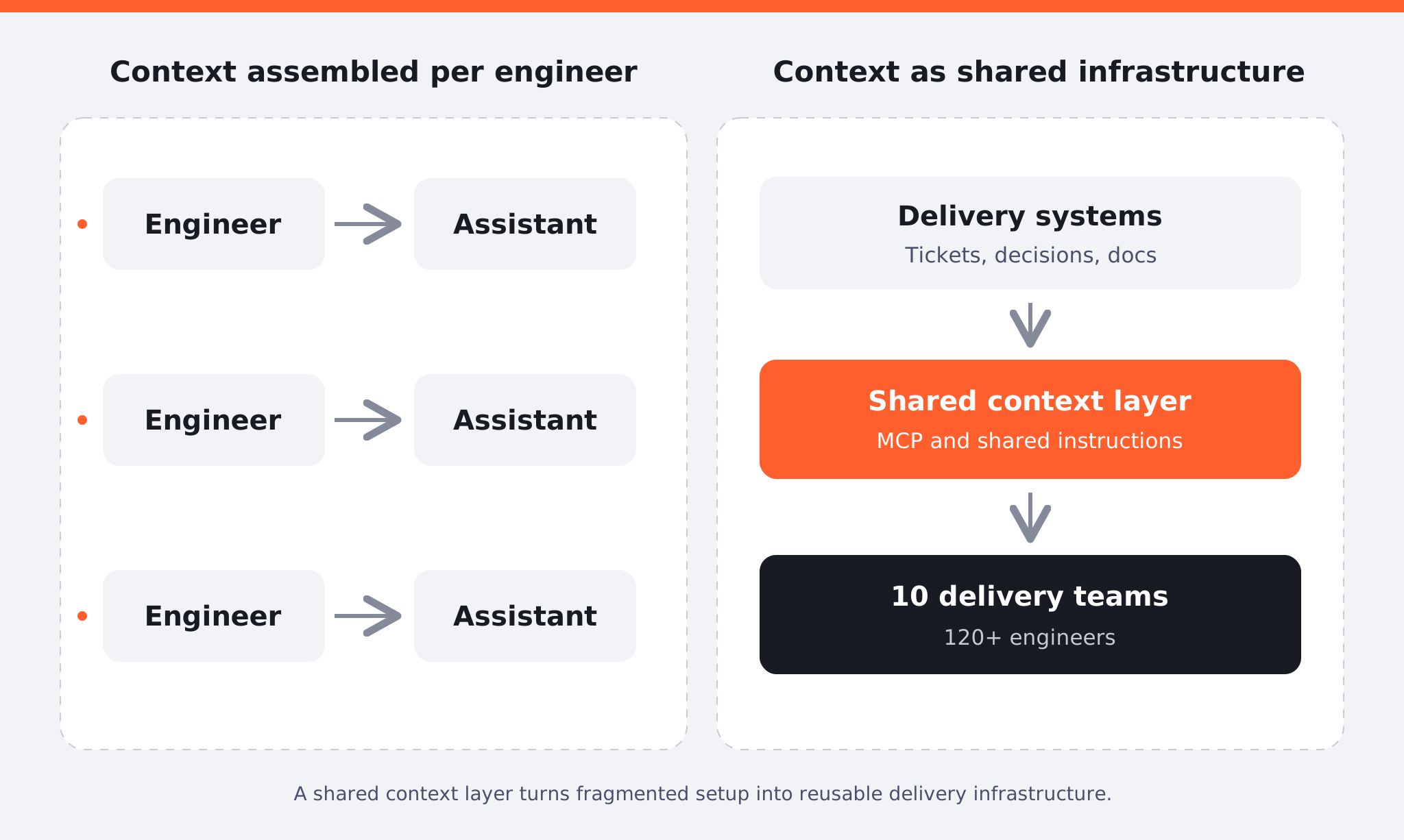
Adoption was personal. Each engineer hand-assembled the context an AI assistant needed, pasting requirements, ticket detail, and architectural decisions into a prompt window at the moment of use. Output quality tracked how well an individual engineer happened to prompt. Nobody could audit an output afterward, because nobody recorded what context produced it. And the context lived in individual habits, so it transferred nowhere. Every team paid the enablement cost again from zero.
Too many enterprise AI engineering programs stall exactly here. A pilot squad posts a compelling number, leadership asks for it everywhere, and the result refuses to reproduce. What made the pilot work never got written down anywhere the next team could reach.
The pilot boundary is a context problem. When the thing that made AI work lives in one engineer’s habits, the next team inherits nothing.
Value Created
GlobalLogic built a structured AI enablement model on a single premise. Context determines output quality, so the organization has to own context as infrastructure.
Two reusable accelerators carried the model.
A reusable skills framework.
A shared enablement package holding standardized AI instructions, reusable prompts, workflow-specific skills, and project-aware engineering guidance. New teams inherited a working configuration instead of discovering one.
MCP-mediated access to the delivery ecosystem.
Model Context Protocol integrations connected AI tooling to the systems already holding delivery knowledge: the issue tracker, business requirements, recorded decisions, and the project knowledge base.
Together these changed what the assistant worked from. It stopped working from whatever an engineer thought to paste and started working from the project’s actual record, under instructions the organization agreed on and could inspect.
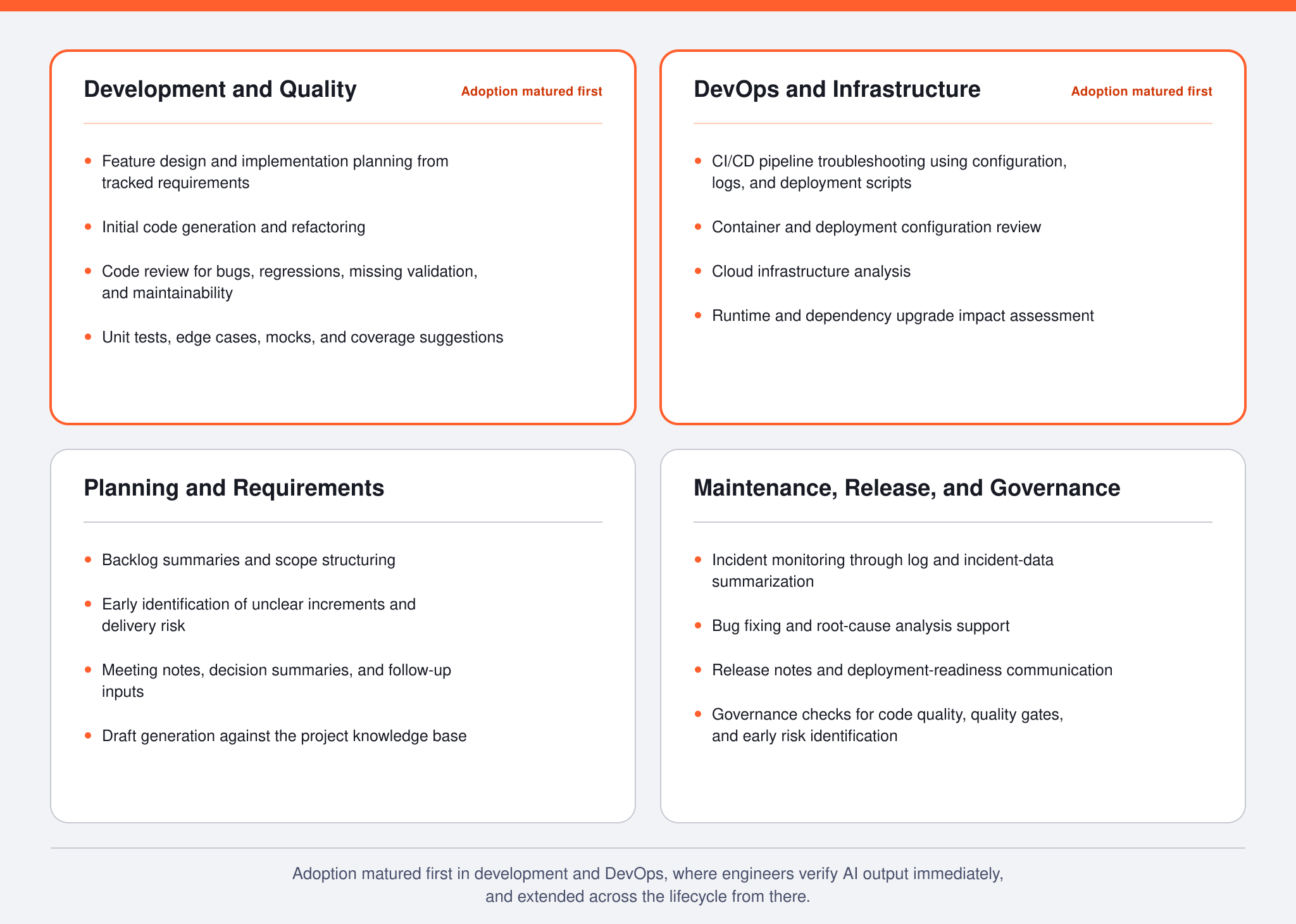
Engineers kept accountability for every decision and every production change.
AI produced first-pass analysis and drafts. Engineers reviewed, tested locally, validated in CI/CD, and checked recommendations against project context before anything moved forward. Shared context strengthened that review, because the assistant and the reviewer worked from the same requirements and decisions.
See how GlobalLogic’s AI-Powered SDLC turns AI assistance into a repeatable engineering capability.
Impact
Adoption across 10 teams and 120+ engineers.
The model crossed the team boundary 10 times instead of stopping with individual enthusiasts or one pilot project. Shared standards and project-aware guidance eliminated duplicated enablement effort every time a new team came on.
Lower and more predictable AI tooling cost.
Standardized instructions and project-aware context cut unnecessary and repeated model interactions. Engineers hit relevant output earlier, which reduced the retries and redundant queries each task demanded.
More consistent engineering output.
Standardized guidance improved completeness across requirements, code, tests, documentation, deployment configurations, and operational artifacts. Human review held each one against project requirements and production constraints.
Most organizations budget governance as a tax on AI spend. Here the standardization that made AI usage auditable is the same standardization that made it cheaper to run.
Nothing here depends on the sector. Any organization running multiple delivery teams against a shared platform meets the same boundary: AI assistance that works for individuals and dies on contact with the second team. The context layer transfers even when the systems beneath it differ.
It also sets up what comes next. Engineering organizations cannot move toward greater autonomy in delivery while context stays personal and unrecorded.
Download Case Study

Featured insights
Explore fresh thinking from GlobalLogic’s strategists and engineers
See all link:


Let’s start engineering impact together.
GlobalLogic provides unique experience and expertise at the intersection of data, design, and engineering.
 How can I help you?
